
Hegelian Self-Reflection for Improved Mathematical and Symbolic Reasoning, and Scientific Discovery in Large Language Models
- Sara Abdali ,
- Can Goksen ,
- Michael Solodko ,
- Saeed Amizadeh ,
- Julie E. Maybee ,
- Kazuhito Koishida
preprint |
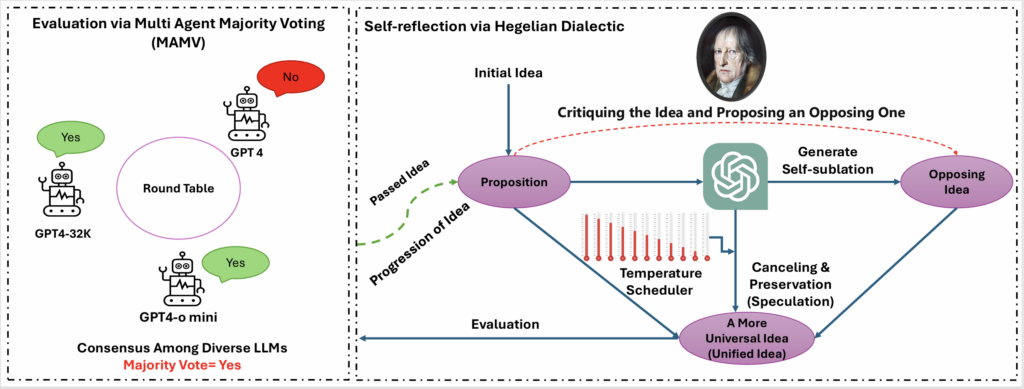
In this paper, we introduce a self-reflection framework for Large Language Models (LLMs) grounded in the Hegelian Dialectic, a philosophical method in which an initial proposition is challenged by a generated opposition, and both are reconciled into a unified, more comprehensive idea. We formalize this process as an iterative operator over the space of consistent theories and apply it to two complementary tasks: (i)generating novel scientific ideas across domains such as mathematics, physics, economics, and philosophy, and (ii)improving reasoning by enabling LLMs to identify and correct their own errors through structured self-critique.
We study generation temperature through two configurations (a dynamic annealing schedule that shifts from creative exploration to refinement, and a constant temperature), to examine the effect of fixed versus dynamic temperature rather than advocate either. To evaluate ideas without domain experts, we introduce Multi-Agent Majority Voting (MAMV), in which multiple LLMs independently assess the validity and novelty of each synthesis. Our experiments show significant gains over baselines on mathematical (GSM-8k, GSM-hard), symbolic (GSM-Symbolic), and knowledge-intensive (MMLU Pro) reasoning, with promising qualitative results in open-ended scientific ideation.